Sports Chiropractic & Physiotherapy, Built Around Movement
Patients arrive at our Crestview clinic wanting to know why the pain started, whether something structural needs attention, and what it will actually take to get back to training. That is what this program is built to answer.
This is a movement-based practice. We treat the joint or muscle that hurts, but we also look at how it moves, how it loads, and how the rest of the body is compensating around it. A stiff hip changes how a knee tracks. The shoulder is an even clearer example: the shoulder blade is a bone, and it only glides correctly when a complex set of muscles pulling in different directions coordinates properly, allowing the joint to press, pull, and stabilize through a very large range of motion. Scapular dyskinesis, trigger points in the rhomboids, or overactive upper traps with tender fibers can each pull the scapula inward so that it stops gliding the way it should, and what surfaces is impingement or glenohumeral joint dysfunction. When one area is damaged, injured, or underperforming, others compensate and the movement pattern changes, so we assess dysfunction across all of the structures acting on that joint — and it is usually more than one. Pain is often the last thing to show up in a chain of problems that started somewhere else, which is why our evaluations go beyond the painful spot itself.
We are built for people who train. Our patients are bodybuilders, powerlifters, MMA and combat-sports athletes, special operations and other military personnel, law enforcement and first responders, competitive and recreational athletes, and the everyday gym enthusiast who trains hard and wants to keep training. If your problem is an acute musculoskeletal injury and your goal is getting back to full capacity, this clinic is set up for you. Alpha Care is located inside Temple Fitness of NWF at 1133 Industrial Drive in Crestview, which means rehab, retraining, and return-to-load programming happen in the same building — and you do not need a gym membership to be seen.
It is worth being equally clear about what we are not. Our exam methods, equipment, and programming are built for patients who can tolerate and progress under load, and some populations need something different.
Geriatric and frail adult patients. Techniques and instruments designed for frail patients exist and work well — they are not what this clinic is built around. Care that has to be managed around advanced osteoporosis, significant frailty, or complex comorbidity belongs somewhere equipped for it.
Infants, toddlers, and young children. We do not perform infant or toddler adjusting of any kind. Care here is limited to patients 15 and older, with rare exceptions for young athletes whose musculature and training level make this the right setting.
Pregnancy. We will gladly care for you through the end of the first trimester. Past that point, fetal development calls for providers trained for it, and we refer you out.
When your needs extend beyond what this setting can responsibly provide, we explain the findings, discuss reasonable options, and refer or co-manage with a clinician whose scope and expertise add what your care requires.
Injuries We Treat
Most of what we see is acute neuromusculoskeletal injury — something that happened, or something that flared up, and it is keeping you out of the gym, off the mat, or off duty.
Strains, Sprains & Ligament Injuries
Hamstring and quad strains, calf tears, groin and adductor strains, rotator cuff and pec strains, ankle sprains, wrist and elbow sprains, knee ligament irritation. These are graded on exam, managed early to protect healing tissue, and then progressively reloaded — because a strain that is rested until it stops hurting and then thrown straight back into full training is the classic setup for re-injury.
Disc Flare-Ups & Herniations
Lumbar and cervical disc injury covers a wide spectrum, from a disc that is irritated and referring pain to a frank herniation with nerve involvement. Exam determines which you are dealing with, whether there is true neurological compromise, and whether the presentation is one that responds well to conservative care. Most do. Care is directional and specific — positions and loading that reduce your symptoms, not a generic back program — combined with graded loading for the muscles that support the spine.
Tendon Injuries, Muscle Spasm & Trigger Points
Tendinopathy is primarily a load-management problem rather than a classic inflammatory condition. Inflammatory processes can still contribute, particularly early in the course, but the degenerative tendon changes that keep the problem going respond to progressive tendon loading rather than to rest. Patellar and Achilles tendinopathy, tennis and golfer's elbow, rotator cuff tendinopathy, and gluteal tendinopathy are managed with a structured loading progression. Acute muscle spasm and trigger points are treated hands-on — myofascial release, instrument-assisted soft-tissue work, and targeted manual therapy — to break the guarding pattern so productive loading can start.
Achy Facet Joints, Low Back & Neck Pain
Low back and neck pain are rarely one thing. Pain can come from a facet joint, a disc, the sacroiliac joint, or an overloaded muscle, and treatment for each is different. We work out which structures are actually contributing using orthopedic testing and movement assessment rather than treating "low back pain" as a single diagnosis. Facet-driven pain in particular responds well to specific joint work paired with the right loading — but a spine that only gets adjusted and never gets stronger tends to keep coming back for the same reason.
Cervicogenic Headaches
Cervicogenic headaches originate in the neck rather than the head. The pain is often felt behind the eyes, at the temples, or at the base of the skull, but the source is cervical — joints, deep neck musculature, and the upper trapezius and suboccipital group. They are common in the populations we treat: fighters and combat-sports athletes, military and tactical personnel, and heavy lifters, where the mechanism is usually neck strain, repetitive loading through the cervical spine, or direct impact.
When exam confirms a mechanical cervical source, manual therapy to the cervical and upper thoracic spine, combined with soft-tissue work and deep neck flexor and postural strengthening, can meaningfully reduce both frequency and intensity.
Headaches also have upstream drivers that have nothing to do with the neck. Blood sugar instability, dehydration, nutrient deficiencies such as magnesium or riboflavin, poor sleep, and systemic inflammatory load all lower the threshold at which a headache fires. Because this is also a functional medicine clinic, when the history points that direction we can evaluate the metabolic and inflammatory contributors through functional medicine testing rather than treating the neck repeatedly and hoping it holds.
Return-to-Play Rehabilitation
Whether the injury is a hamstring strain, an ankle sprain, tennis elbow, or a flare-up from training too much too fast, the principle is the same: settle the tissue down, restore full pain-free motion, then rebuild strength and control before returning to sport or heavy training. The settling and the motion work happen in office with our hands on you. The rebuilding happens in your own training, on a program we design and then reassess. Return-to-play decisions are based on objective measures — strength, range of motion, and how the tissue tolerates load — not on how many days have passed. We work with in-season athletes who need to keep training around an injury and with anyone who wants a realistic plan to get back without re-injury.
How We Evaluate: A Movement-Based Exam, Not a Five-Minute Adjustment
The first visit is a clinical evaluation, not a treatment on autopilot. We begin by listening to your story — when the pain started, what makes it better or worse, prior injuries, training or work demands, what care or imaging has already been done, what changed or did not, and what matters most to you personally about getting back to the things you do. That history tells us what we are looking for and shapes the diagnostic assessment plan: which structures, movements, and red flags need a closer look, whether imaging may be useful, or, in rare cases, whether a specialist is needed for something outside our scope. Then the physical exam has several layers:
- Orthopedic and neurological testing. Specific tests help identify which structures are likely involved — disc, joint, nerve, tendon, or muscle — and rule out red-flag findings that would need medical imaging or referral rather than manual care.
- Joint-by-joint assessment. We check mobility and quality of motion at the spine and the joints above and below the area of pain, since restriction in one joint often shows up as pain somewhere else along the chain.
- Movement screening. How you squat, hinge, rotate, and reach tells us more than a static exam alone. Compensations that look minor at rest often become obvious under load or repetition.
- Load tolerance. We test how much a tissue or joint can handle before it reacts, which shapes both the manual therapy plan and how quickly we progress rehabilitation exercise.
Most patients do not need imaging to start care. X-ray or MRI becomes appropriate when there is a history of significant trauma, neurological findings such as numbness, weakness, or loss of reflexes, symptoms that fail to respond to a reasonable course of conservative care, or red-flag signs that suggest something outside the scope of chiropractic and physiotherapy management. When imaging or a specialist opinion is warranted, we refer out and coordinate care rather than continuing treatment that is not appropriate for the finding.
Plan for a first visit that runs longer than an adjustment-only appointment. Most patients leave it with an initial treatment — manual therapy, soft-tissue work, or corrective exercise, depending on findings — and a clear plan for what the next several visits will address.
How Treatment Actually Works
Whether the finding is a fixated joint segment, a herniated disc, an inflamed facet or bursa, a torn labrum, an impingement, or a strain, we treat the whole case rather than the single structure that hurts — soft and connective tissue, trigger points, the ligaments supporting the joint, the muscles pulling on it, and the kinetic chain they belong to. Fixing one problem and leaving another in place to damage it a second time is not a plan. And it is not a single technique repeated every visit; it is a sequence that shifts as you improve.
Early phase — get the pain, spasm, and inflammation down and the motion back. The first visits are hands-on and they happen in office. The priority is quickly reducing pain, muscle spasm, and inflammation and restoring range of motion, using chiropractic adjustment and manual physiotherapy to the affected joints combined with soft-tissue work — myofascial release, instrument-assisted techniques, and targeted stretching — for the muscles that are guarding or compensating. The goal is a nervous system and a set of tissues that are ready to do productive work, not just less pain for an afternoon.
Then you leave with active rehabilitation to do, and we reassess. Once the acute pain is settling, you go home with specific active rehabilitation exercises and we bring you back in a few days to see what changed. That reassessment drives everything that follows. Each visit the in-office work progresses to more intensive myofascial release and soft-tissue work, mobility and stretching, and we go over the dynamic movement patterns you will actually be using to return to play. We set the specific exercises, the working ranges, and the weight loads, along with guidance for continuing to train outside the clinic. Then we reassess again and adjust the exercise progression and the pain management as needed, working on the underlying cause rather than the symptom, so you get back to playing and performing as fast as the tissue allows.
We do not charge you to come in and count your reps. This is a deliberate model. Many of our patients are athletes who already train seriously, and the clinic is located inside a gym. Your visit is spent on the things that require a clinician's hands and a clinician's judgment — treatment, reassessment, and prescription. The loading itself is yours to execute. What we owe you is that you walk out understanding exactly what you are doing, at what range, at what intensity, and at what load, and how to perform it correctly in the gym. You leave with a program built for the equipment you have and the time you realistically have for it — not a stapled sheet of twenty generic stretches, but a short list of the specific things that will move your case forward. Where it makes sense we hand patients back to well-educated personal trainers with specific treatment guidelines, so the coaching and the clinical plan point the same direction.
In practice, most of our patients notice meaningful change within one to three sessions. That is the standard we hold ourselves to, and if you are not responding the way your findings predict, that is information — it tells us the working diagnosis or the plan needs to be revisited, not that you need more of the same treatment.
Care here has an end point tied to those milestones rather than an open-ended maintenance schedule. Some patients choose periodic check-ins afterward, particularly athletes in ongoing training, but that is a choice made once the problem is resolved, not a default plan.
Class 4 Laser Therapy
Class 4 laser is a medical-grade laser, and for most patients it works best as an adjunct to a chiropractic or physiotherapy appointment — added to the visit for pain relief and to accelerate healing in an irritated area so that productive work can begin sooner.
When the findings tell us an area will respond well to a course of it, we plan a defined number of sessions for that condition rather than adding a few minutes of laser to unrelated visits. If we know a surgical scar will take three to six sessions, or six to eight, before it is tolerable and visibly improving, we say so upfront. Which applies to you is guided by clinical evidence and by what we are seeing in the tissue.
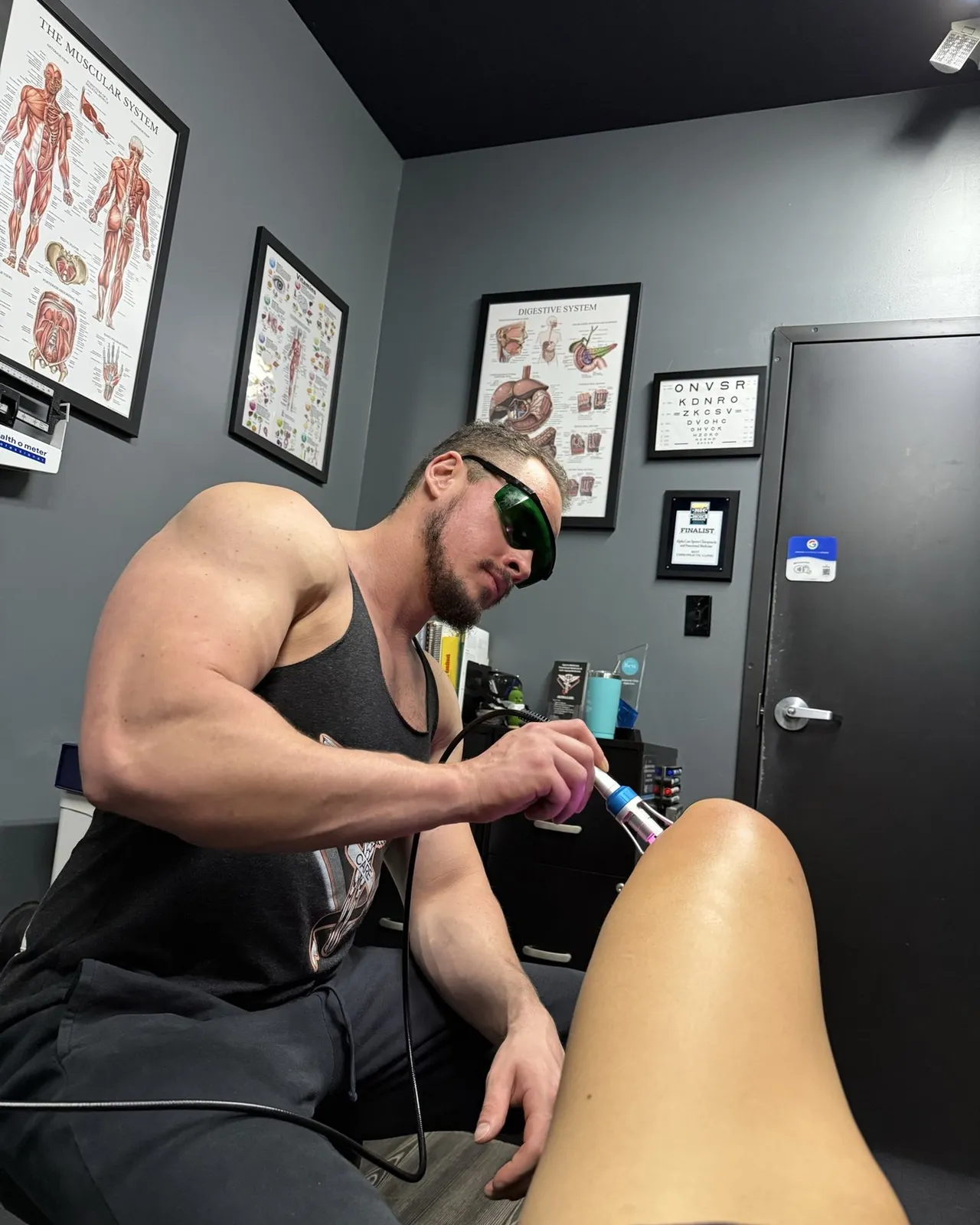
Laser is also used on its own, without hands-on treatment in the same visit. That usually happens in two situations. The first is a recent surgical procedure or a joint that is still immobilized — a cervical collar, hardware in place, or a repaired soft-tissue rupture — where manual therapy and loading are simply not options yet but healing and pain still need addressing. The second is between chiropractic and physiotherapy appointments, as additional management while the tissue rests and recovers between hands-on rehabilitation and therapeutic exercise. In both cases it is scheduled as its own treatment, often in packages.
Presentations where a prescribed course tends to be worth it include:
- Bursitis and tendinopathies, along with other persistently inflamed structures that keep re-irritating with movement.
- Overuse damage and chronic inflammation, where the tissue has been provoked repeatedly over months rather than injured in a single event.
- Neuropathies, where the goal is calming an irritated nerve rather than loading it.
- Post-surgical scarring, where pain, inflammation, incision healing, and how the scar ultimately looks are all priorities — the cosmetic side responds to repeated sessions for patients who care how it ends up, not only how it feels.
- Rehabilitation after immobilization, when tissue has been offloaded for weeks and needs help tolerating motion again.
- Deep soft-tissue injuries such as disc herniations, labral tears, or bone inflammation. These often need a period of pain-free, passive improvement and accelerated healing before the body is ready for physiotherapy and movement rehabilitation at all, and laser is one of the few tools that contributes during that window.
Laser is not appropriate for every patient or every finding, and it is never the whole plan. Whether it belongs in yours is a clinical decision based on your exam.
Why Patients Choose Alpha Care
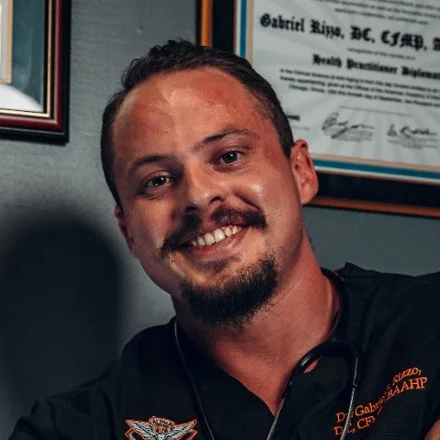
Alpha Care Sports Chiropractic and Functional Medicine is led by a clinical team built around Dr. Gabriel Rizzo, a Florida-licensed chiropractic physician and physician-level integrative provider who holds a Bachelor of Science in Exercise Physiology and physiotherapy certification through the NBCE. That exercise physiology background is part of why exercise prescription, progressive loading, hands-on treatment, and rehabilitation receive equal attention. The goal is not simply to address pain, but to rebuild capacity for training, work, and everyday life.
A former high-level competitive powerlifter, Dr. Rizzo broke multiple national and state records, briefly holding the USPA American Record in both the squat and the bench press. He still trains, and has picked up Brazilian jiu-jitsu and boxing.
Recovery from a musculoskeletal injury is also affected by things that have nothing to do with the joint itself. Sleep quality, inflammation, protein intake, and micronutrient status all influence how quickly tissue heals and how well it tolerates the loading required to rebuild strength. When a patient's recovery is stalling for reasons that look more metabolic than mechanical — persistent inflammation, slow healing, unexplained fatigue alongside the injury — our clinical team can connect that picture to functional medicine evaluation, so the rehabilitation plan and the metabolic picture are addressed together rather than in isolation.
Our philosophy carries over from how we think about labs and hormones to how we think about musculoskeletal care: in range is not always optimal. Pain-free is a reasonable short-term goal, but it is not the same as fully rehabilitated, and we build programs toward the second standard.
We see patients from Crestview, Niceville, Destin, Fort Walton Beach, and Laurel Hill who want a program that treats both the pain and the reason it kept coming back.
Frequently Asked Questions
Do I need a referral to see a sports chiropractor?
No. You can schedule directly for an evaluation. If your history or exam findings suggest you need imaging or a specialist first, we will refer you at that point rather than proceeding with manual care that would not be appropriate. Most musculoskeletal complaints, however, can be evaluated and treated without a referral.
How is this different from a typical chiropractic adjustment?
A typical adjustment-only visit addresses joint motion in the moment. Our approach adds orthopedic and neurological testing, movement screening, and a prescribed rehabilitation program built around strengthening the tissues that support the joint, so the improvement is meant to hold rather than require repeated maintenance visits to sustain. In office we work on pain, spasm, inflammation, and range of motion with our hands. The strengthening you carry out in your own training, on a program we write, review, and progress at each reassessment — we do not bill you to supervise sets.
Will I need X-rays or an MRI?
Not usually at the first visit. Imaging is appropriate when there is significant trauma, neurological symptoms such as numbness or weakness, findings that suggest something beyond a mechanical issue, or a lack of expected progress after a reasonable course of conservative care. We order or refer for imaging when the exam indicates it is genuinely needed.
How many visits will I need, and how fast should I expect results?
Fewer than most people expect. Most patients see meaningful change within one to three sessions, and a full return-to-capacity plan is usually a short, defined course of visits rather than an open-ended schedule. We set measurable milestones at the outset — pain, restored motion, specific strength or performance benchmarks — and the plan ends when those are met. Longstanding injuries and post-surgical cases take longer, and we will say so upfront. If you are not responding as your exam findings predict, we reassess the working diagnosis rather than repeating the same treatment and hoping it lands.
What if my pain is connected to something metabolic, like poor sleep or inflammation?
That connection is common, and it is one reason recovery sometimes stalls even with good rehabilitation technique. If your history suggests inflammation, nutrient status, or hormonal factors are slowing healing, our clinical team can extend the evaluation into functional medicine testing so the musculoskeletal and metabolic sides of recovery are addressed as one plan. Learn more about the rest of what we do on our services overview.