Our Philosophy and Standards of Care
Once you know what we treat, the more useful question is how we decide what to do about it — what gets measured, what gets considered, and what you get told before anything starts. Everything below is the standard we hold ourselves to at every visit. It is written down so you can hold us to it too. See what we treat →
Why Alpha Care?
Plenty of clinics can hand you a prescription. What you should be asking is how the decision behind it was made — what was actually measured, what else was considered, and whether anyone explained the trade-offs to you before you agreed to it.
Principles
We stand on our philosophy.These are not marketing lines. They are the rules we practice by, and they hold even when a shortcut would be easier or more profitable.
The foundation comes first
You cannot medicate a poor diet or supplement past inadequate sleep. Nutrition, sleep, movement, stress load, and the other foundations of health are addressed before anything is layered on top of them — and they stay part of the plan afterward.
The whole person, not a symptom list
Physical, metabolic, and mental and spiritual health are all part of the same picture, and for many patients faith is a genuine part of resilience. Your genetics run through all of it as the baseline we work with rather than something to argue against.
Every recommendation has to be justified
Peer-reviewed literature, a mechanism we can explain out loud, and a defensible view of both the short-term and the ten-year impact. If we cannot tell you why, it does not go in the plan.
The smallest effective set
Medications and supplements are tools, not trophies. We use them deliberately when they are the right tool, monitor them with repeat labs, and take them back off as the underlying problem improves.
Systems, not single numbers
One marker in isolation is rarely the answer. Hormones, thyroid, iron, inflammation, and metabolic markers all move together, so we manage the whole axis instead of chasing one value on a report.
Labs Guide; How You Feel Decides
Comprehensive lab work, performed when clinically needed, guides the plan and helps keep you safe. But how you feel and how you respond to care carry equal weight. We track both with repeat analysis, because the markers and your symptoms both need to move.
We treat people, not numbers
Numbers are an evidence-based guide for understanding your individual biochemistry, where your systems are functioning well or poorly, and how those systems interact with each other. They inform the plan and they keep the plan honest. But a lab report is not the patient, and we treat people, not numbers.
We Are Medical Detectives
We look beyond the obvious.Comprehensive lab work is performed when clinically needed to help evaluate the full picture: your symptoms, possible underlying contributors, associated causes, and your risk. It can help identify pathology that may already be present while also informing preventive care and long-term health. Labs are a guide, not a verdict — a safety check that helps us ask better questions, make informed decisions, and choose the next right step.
The goal is to help you feel and function at your best. Repeat analysis lets us follow your chemistry, reduce risk, and monitor treatment progress over time. But those results are always read alongside your day-to-day experience: how you feel, what has changed, and how you are responding to care. A marker improving matters, and so does whether you are actually improving.
When the lab work and your symptoms do not tell the same story, we do not dismiss either one. If your bloodwork does not improve, your symptoms do not improve, or one changes while the other does not, the plan may need to change. Especially when the markers look excellent for what we were addressing and you still feel unwell, that is a signal that something may be missing. We look deeper and use additional testing when clinically appropriate to understand why.
That is why we think like medical detectives. A single symptom can have many possible causes; fatigue alone can trace back to a hundred different factors. Rather than guessing or treating a label in isolation, we evaluate the possibilities that fit your history, exam, symptoms, and testing. The point is not to chase every test. It is to find the contributors that explain why you do not feel right, then build a plan around the full picture.
What Makes Us Different
Evaluation, treatment, honesty, and change that lasts.Evaluation
We begin by listening to your story, not rushing through a five-minute intake: your symptoms, concerns, goals, where this started, what has already been done, including prior testing or treatment and what did or did not help, and what matters most to you personally. That tells us what we are looking for and lets us develop a diagnostic assessment plan: clinically relevant laboratory testing, potentially imaging, and, in rare cases, referral to a specialist when a concern is outside our scope.
We treat people, not numbers. Numbers are an evidence-based guide to your individual biochemistry, function or dysfunction, and the interactions among body systems. We incorporate the whole person into the analysis, evaluation, treatment plan, and interpretation of results, so the same value is not treated as meaning the same thing for everyone. Results are read against functional ranges rather than population averages and alongside your symptoms, priorities, and response to care. When something falls outside our scope, we refer and co-manage rather than guess.
Treatment
Treatment is built from your findings, not from a template. Manual and rehabilitative care, therapeutic nutrition, targeted supplementation, hormone therapy, and prescription medication all have a legitimate place — used when the clinical picture calls for them and sequenced so each one can actually work.
Every intervention comes with a stated target: which finding it addresses, what we expect it to change, and how we will know whether it worked in both repeat labs and how you feel. Then we retest, listen, and adjust.
Honesty
We will tell you when something is unlikely to help, when the evidence is thin, when a therapy is off-label, and when the honest answer is that you do not need what you came in asking for. We would rather lose the sale than sell you a protocol you do not need.
We also tell you what we do not know, and what a treatment cannot do. Realistic expectations set at the start are part of the treatment.
Real lifestyle change that lasts
A plan you abandon in three weeks is not a plan. We build inside your actual parameters — your schedule, your job, your training, your budget, your kitchen, your injuries, your family — and around the goals you brought in, not the ones we would pick for you.
That usually means fewer changes at once, each one specific enough to execute and durable enough to keep. The objective is a way of living you can still hold onto in five years, not a sprint that resets the moment life gets busy.
All the options, and the trade-offs
You get the full menu — including watchful waiting, the conservative route, and doing nothing for now — with the risk and the reward of each one laid out in plain language. Benefits, side effects, cost, monitoring burden, what it commits you to, and what happens if we hold off.
Nothing starts until you understand the pros and cons of your situation and your choices well enough to explain them back. Informed consent here means genuinely informed.
Designed together
The final plan is one we build with you, not one handed to you. It has to be comprehensive, evidence-based, and effective — and it also has to be a plan you believe in, because adherence is what actually produces the outcome.
Your priorities, your tolerance for risk, and your definition of a good result all shape the decision. You leave knowing what we are doing, why, what comes next, and how we will measure it.
The work you do not see
Most of what goes into your plan happens when you are not in the room. Your chart gets read start to finish, your labs get worked through line by line rather than skimmed for red flags, and the options get built against the current literature for your specific presentation.
That work happens on nights and between patients, and it is a real part of what a visit here covers. You are not paying for the minutes your physician spends in the room with you — you are paying for the reasoning that shows up when you get there.
No promises we cannot keep
Medicine does not come with guarantees, and we do not offer one. Two patients with the same labs and the same plan can end up in different places, and any clinic telling you otherwise is selling something.
What we do commit to is a thorough evaluation, the reasoning behind every recommendation, honest expectations set at the start, and a course correction the moment something is not working. The plan still has to be lived out, and that part is yours — but you will never be doing it without a physician who is paying attention.
The short version: we measure before we treat, we explain before we treat, we tell you the truth about what will and will not help, and we build a plan you can actually live with. No guarantees, no theatrics — just careful work, done the same way every time. See how that works in practice →
Foundation First
You cannot medicate a poor diet, and you cannot supplement your way past inadequate sleep. Lasting health is built on a foundation, and everything else is built on top of it.
Our model is simple. Your body constantly absorbs load and constantly repairs. You stay healthy while your capacity to heal, detoxify, and recover stays ahead of that load. Pain and disease appear when it falls behind. A hamstring tears because force exceeded what the tissue could tolerate that day; a liver fails after decades because exposure outran repair. Same equation, different clock.
So we assess the foundation first. These are the variables that decide how much load you can carry and how quickly you recover from it, and they are the first thing we evaluate in every patient regardless of what brought them in.
Diet
Whole-food intake, adequate protein, micronutrient density, and stable blood sugar. Not a branded diet — a pattern of eating that supplies the raw material every other system depends on and that you can actually sustain.
Lifestyle
Daily structure, work demands, alcohol and nicotine, and consistency. What you do on most days determines far more than what you do occasionally, and the plan has to survive your actual schedule.
Exercise
Cardiovascular conditioning and resistance training matched to your goals, age, body composition, and health status. Every patient is assessed on how they train and whether the intensity is adequate, not only those who arrive injured.
Toxic Burden
Cumulative chemical exposure weighed against your capacity to process and clear it. This is graded rather than binary, and it includes what you eat, drink, breathe, apply to your skin, and absorb secondhand.
Sleep
Repair happens during sleep. Hormone production, glucose control, tissue healing, immune function, and appetite regulation all depend on it. Sleep debt lowers your capacity without changing a single exposure.
Mental & Spiritual Health
Coping capacity is a physiological asset. Chronic unmanaged stress drives cortisol, disrupts sleep, degrades food choices, and blunts recovery, and past experience is not irrelevant to a present symptom. For many patients, faith and prayer are a genuine and load-bearing part of that grounding.
Environment
Where you spend your hours. Air and water quality, mold, light exposure and its timing, workplace conditions, heat and cold, and the physical demands of your day all register as load.
Social Support
Relationships, family, and accountability. Isolation is a measurable health risk, and reliable support is one of the strongest predictors of whether a plan is followed long enough to work.
Genetics
The one input you cannot change — which is exactly why it runs through all of the others rather than sitting beside them. Variants affecting methylation, detoxification, vitamin D receptor activity, and nutrient metabolism change how much of each foundation you personally require. Genetics is not destiny here; it is the reason two patients on an identical plan do not get an identical result.
Then the data. Advanced laboratory work read against functional ranges rather than population averages guides targeted correction, with repeat testing to confirm the markers moved and your symptoms and response to care are moving in the right direction. Prescription therapy when it is clinically warranted — placed on top of a foundation that will let it work, never in place of one.
Then the why behind every prescription. Once the foundation is in place and the testing is back, anything we add has to earn its place. We should be able to tell you exactly which finding it addresses, what we expect it to change, and how we will know whether it worked.
Supplements replace what is measurably low or supply a cofactor your biochemistry demonstrably needs — because a lab value is deficient, because absorption is impaired, because a medication depletes it, or because a genetic variant raises your requirement. Form and dose matter as much as the ingredient. If a supplement is not doing identifiable work, it comes off the list.
Hormone therapy restores a signaling system that has genuinely declined, on a foundation capable of supporting it. That means managing the whole axis rather than one number — estradiol, thyroid, hematocrit, and iron all move with treatment, and ignoring them is how patients end up with more complaints than they started with. It is not a way to bypass a nutrient deficiency or a sleep problem, and it will not perform like one.
Prescription medication can be an important part of comprehensive care when clinically appropriate. Dr. Rizzo evaluates the full clinical picture and works closely with licensed medical prescribers when pharmaceutical management is warranted, while continuing integrative co-management around laboratory findings, nutrition, metabolism, lifestyle, and treatment response.
All of it is evidence-based and reasoned out loud. Every recommendation traces back to peer-reviewed literature and a mechanism we can explain — why this marker matters, why this dose, why this sequence — rather than to a trend or a single anecdote. And every decision is justified twice: against the problem in front of us today, and against where it leaves you in ten years. Treating what brought you in and building toward optimal function are the same plan here, not competing ones.
The categories below are for scheduling, not for biology. Your gut influences your hormones, your hormones influence your body composition, your training influences your insulin sensitivity and your mood, and your sleep influences all of it. We group care so you know what to book. We never treat those groups as separate problems, and the plan is different for every patient even though the objective never changes. Read the full clinical rationale →
Practice informed by peer-reviewed research
Dr. Rizzo’s work in the clinic is grounded in the same standard he applies in the medical literature: careful review of the evidence, respect for individual physiology, and a commitment to whole-person outcomes rather than isolated laboratory numbers.
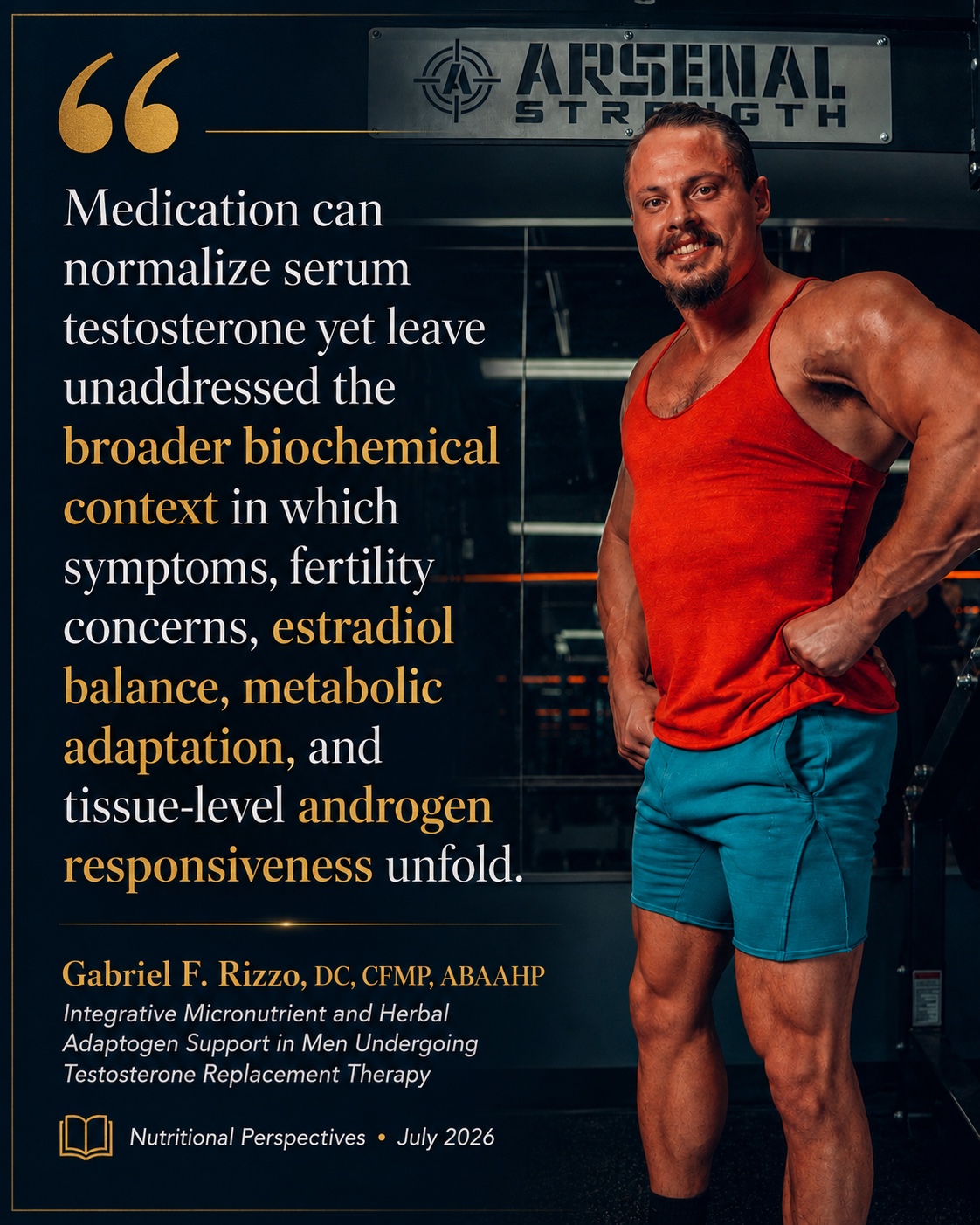
Integrative Micronutrient and Herbal Adaptogen Support in Men Undergoing Testosterone Replacement Therapy: A Mechanistic and Clinical Narrative Review.
Published in Nutritional Perspectives (2026), this peer-reviewed clinical narrative review examines how micronutrient status and select herbal adaptogens may influence the broader biological environment in which testosterone replacement therapy is delivered. The paper argues that TRT should be understood as part of a wider endocrine and metabolic system, rather than as an isolated pharmacologic event — and that medical management and physiologic optimization are not mutually exclusive.
The review synthesizes current evidence around key nutrients such as vitamin D, zinc, magnesium, and selenium, along with adaptogenic botanicals with clinical relevance to men on hormone therapy. It highlights the ways in which micronutrient sufficiency, metabolic health, estradiol balance, fertility considerations, and tissue-level androgen responsiveness all shape how a patient actually feels and functions on treatment — not just what their serum testosterone reads on a lab report.
That is the same lens Alpha Care brings to every patient. Laboratory findings, symptoms, nutrition, metabolism, treatment response, and the person in front of us all matter. Care is designed to be evidence-based and personalized, not templated.
Rizzo GF. Integrative Micronutrient and Herbal Adaptogen Support in Men Undergoing Testosterone Replacement Therapy: A Mechanistic and Clinical Narrative Review. Nutritional Perspectives. 2026;49(3):9–21.

Practical details for new patients
A few things worth knowing before your first visit — how our clinic model works, what visits cost, and answers to the questions we hear most often.
Cost & Insurance
Alpha Care is a self-pay clinic. That means every visit, laboratory decision, and therapy is shaped by what your care actually needs — not by what an insurance company is willing to reimburse. Fees are shared before services are scheduled, and you will never be surprised by the cost of an appointment.
HSA and FSA funds may be used for eligible clinic expenses. Insurance may still apply to covered medications and laboratory services billed directly by the pharmacy or laboratory. Prescription medications and pharmacy charges are not included in clinic fees.
Call for current pricing: (850) 603-8075 →Common Questions
- Do I need a referral?
- No. Most patients book directly. If you would like guidance on which visit to schedule, call the clinic and we will help you match your concerns to the right starting point.
- How is Alpha Care different from other clinics?
- Our team spans sports chiropractic and physiotherapy, hormone optimization, metabolic health, clinical nutrition, and medical aesthetics — working from one connected clinical plan rather than passing you between offices. Visits are longer, laboratories are interpreted with context, and follow-up is coordinated across providers.
- Can you manage my prescriptions?
- Yes. When prescription medication is part of your plan, our clinicians work together so laboratory interpretation, clinical reasoning, prescription management, and follow-up remain part of one integrative plan.
- Where are you located?
- 1133 Industrial Drive, Crestview, Florida — serving Crestview, Laurel Hill, Niceville, Destin, Fort Walton Beach, Navarre, and the surrounding Northwest Florida communities.